General term for all Substances and Preparations directly applied as textile auxiliary agents, inks, dyes or pigments.
") and chemicals approved Chemical inputs used for wet-processing of [GOTS](https://global-standards.org/resources/glossary/gots "The worldwide leading voluntary sustainability standard for the post-harvest textile value chain for certified organic fibres, covering environmental criteria, human rights, social criteria and business conduct.
")/GRTS Goods and [Accessories](https://global-standards.org/resources/glossary/accessories "Items that are added to supplement GOTS Goods for required functional or for fashionable reasons. Most commonly used Accessories are listed in Section 3.3. Accessories also include trims, and in certain cases the two terms are used interchangeably depending on the specific component. The processing of those Accessories is not under the direct scope of the GOTS on-site certification system. GOTS criteria that applies to Accessories are listed in Sections 3.3 and 5.2.8.
") used for functional and/or fashionable reasons are collectively called Additives. Both categories have different technical requirements in line with their production and usage. With the implementation of GOTS Version 7.0, chemical [formulators](https://global-standards.org/resources/glossary/formulator "An organisation involved in manufacturing, producing or creating a mixture of chemical Substances blended together (Formulation) to be used for textile processing.
") are required to implement product stewardship practices and undergo an on-[site](https://global-standards.org/resources/glossary/site "An individual establishment where chemical Inputs are formulated (see Formulator) and produced. It is included in a Letter of Approval and audited by a Scope 4 Approved Certifier.
") [audit](https://global-standards.org/resources/glossary/audit "A systematic, independent and documented process for obtaining evidence and evaluating it objectively to determine the extent to which the Standard's requirements (including environmental and social criteria) are fulfilled by a Certified Entity or applicant for the status of Certified Entity. Audits are conducted by Approved Certification Bodies (see 'Approved Certification Body').
") for environmental management systems, as well as [occupational health and safety](https://global-standards.org/resources/glossary/occupational-health-and-safety "Regarding all aspects of health and safety in the workplace, with a strong focus on the primary prevention of hazards. The health of workers has several determinants, including risk factors in the workplace leading to cancers, accidents, musculoskeletal diseases, respiratory diseases, hearing loss, circulatory diseases, stress-related disorders and communicable diseases.
"). ## Chemical inputs Colourants and/or textile auxiliaries, which are used for wet-processing of [organic](https://global-standards.org/resources/glossary/organic "'Organic' is a regulated term used to distinguish systems of managed production and products derived therefrom that adhere to principles of health, ecology, fairness and care, and which are certified compliant to an organic standard's regulations by an Approved Certification Body.
GOTS defines organic textiles as being made with fibres from organic agriculture systems that are certified to one of the IFOAM Family of Standards, and that are processed in socially and ecologically responsible ways, in alignment with organic principles.
standard glossary text
") terminology. This includes dyestuffs, pigments, inks, enzymes, sizing agents and other auxiliaries used in textile wet processing operations. Under the Global [Standards](https://global-standards.org/resources/glossary/standard "standard glossary text
") system, only those inputs can be used, which have been assessed and approved according to the Standard by a Scope 4 [Approved Certifier](https://global-standards.org/resources/glossary/approved-certifier "An Approved Certification Body or Approved Certifier is a certification body that has been duly accredited by an Accreditation Body. By signing a con tract with Global Standard gGmbH, they are permitted to implement the Global Organic Textile Standard within a designated geographical area and for specific scopes of the Standard. An updated list of Approved Certifiers and their scopes is available on the GOTS Website.
"). GOTS- and GRTS-approved chemical inputs have been assessed against the applicable input criteria, including specified hazard restrictions and biodegradability and toxicity requirements. Approval does not mean that an input is free from all hazardous [substances](https://global-standards.org/resources/glossary/substances "Chemical elements and their compounds as they occur in the natural state or as produced by industry.
") or guarantee a particular wastewater outcome. [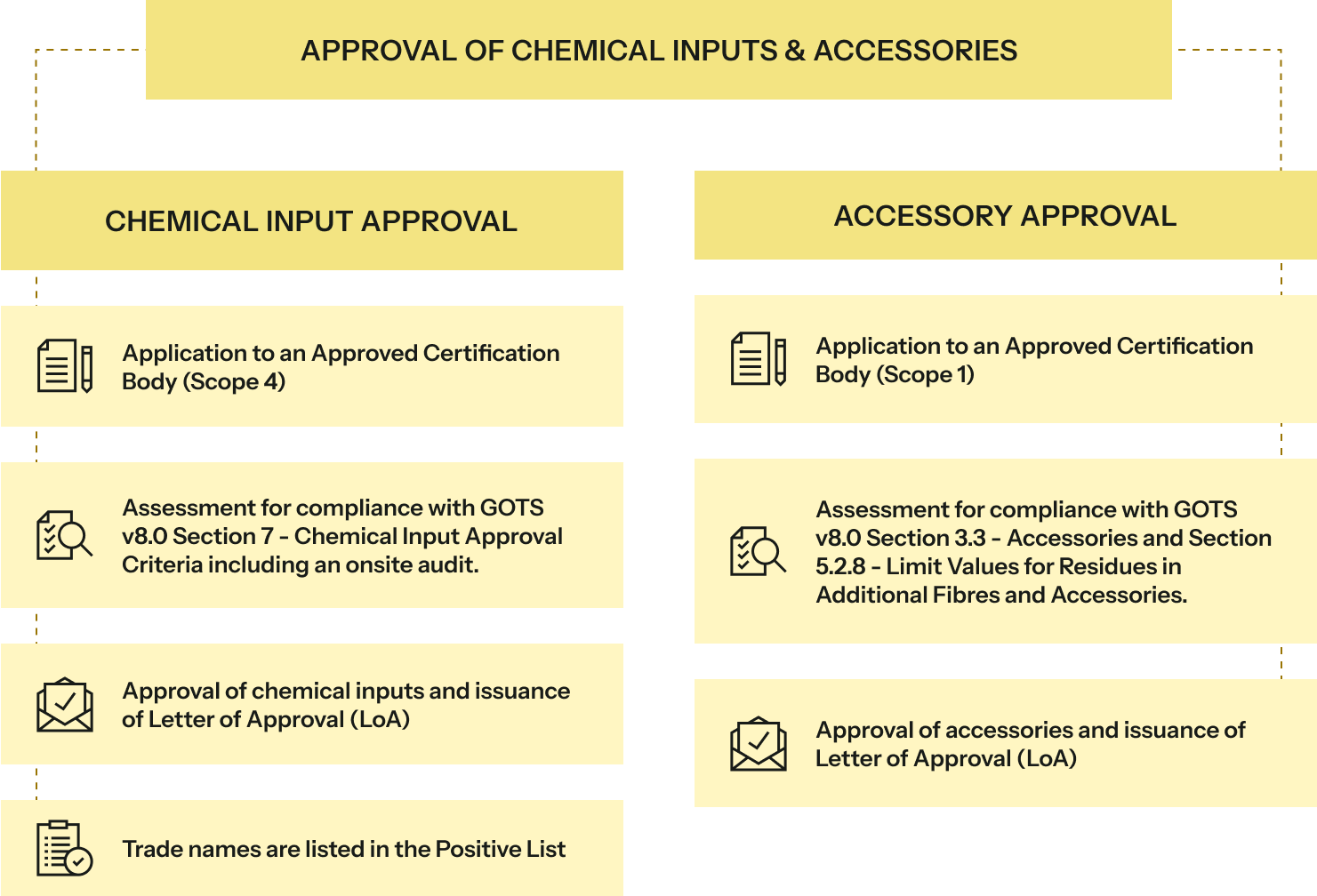](https://global-standards.org/images/Infographics/approved-chemicals-infographic.png)Collectively, this leads to higher interest from suppliers of inputs to obtain GOTS approval for their products. GOTS approved inputs, offered and advertised by the textile chemical industry, are widely recognised and used in the industry. As of June 2020, more than 24.000 trade names of inputs from 700+ suppliers are approved. Suppliers of chemical inputs must hold a prepared and available Safety Data Sheet (SDS), at all times. The SDS must come in a form according to one of the following norms/directives, which contain appropriate information with regard to GOTS criteria, in order to be used as an accepted basic tool for evaluation: • ANSI Z400.1-2004 • ISO 11014-1 • EC 1907/2006 (REACH) • GHS (Global Harmonised System) • EC 2015/830 • JIS Z 7253:2012 Not all GOTS criteria can be assessed solely based on the SDS, as some GOTS criteria are not required to be declared there. Occasionally, an SDS may contain insufficient, contradictory, or even false information. Therefore, the certifiers need to consider additional sources of information, such as independent lab tests, [traceability](https://global-standards.org/resources/glossary/traceability "The ability to trace the origin of an object back to its source.
In a GOTS context, the ability to trace a GOTS Good as it moves through its supply chain.
An entity in the manufacturing chain (sewing industry or so-called CMT (cut, make, trim) industry up to labelling and final packing) of GOTS Goods.
") and suppliers of chemical inputs that wish to have their products approved should contact a relevant Scope 4 [Approved Certification Body](https://global-standards.org/resources/glossary/approved-certification-body "An Approved Certification Body or Approved Certifier is a certification body that has been duly accredited by an Accreditation Body. By signing a con tract with Global Standard gGmbH, they are permitted to implement the Global Organic Textile Standard within a designated geographical area and for specific scopes of the Standard. An updated list of Approved Certifiers and their scopes is available on the GOTS Website.
"). The revisions of the Standard may entail changes or amendments to the requirements for chemical inputs. The colourants and auxiliaries approved under a previous version may therefore need to be reassessed and relisted in accordance with the applicable requirements. Holders of a [Letter of Approval](https://global-standards.org/resources/glossary/letter-of-approval "Official document issued by a GOTS-approved Certification Body listing the approved chemical inputs or accessories for the use in GOTS Goods.
") are subject to an annual Approval Fee based on the number of Chemical Inputs or Accessories listed in the Letter of Approval. The fee is €30 per approved item, subject to a minimum annual fee of €150 per supplier. The Approval Annual Fee is collected by the Scope 4 [Certification Body](https://global-standards.org/resources/glossary/certification-body "A Certification Body, having been duly accredited by an Accreditation Body and by way of signing a contract with Global Standard gGmbH has been permitted to implement the Global Organic Textile Standard over a designated geographical area and for specific scopes of the Standard.
"). A Letter of Approval is valid for one year from the date of approval. With the implementation of GOTS Version 7.0, [chemical formulators](https://global-standards.org/resources/glossary/chemical-formulator "A Chemical Formulator places chemical products on the market under own trade name. Generally the recipe, formulation and processing know-how belong to the Chemical Supplier. These chemical products can be manufactured by either the Chemical Supplier itself, or another Chemical Formulator or a toll-manufacturer.
") are required to implement product stewardship practices and undergo an on-site audit for environmental management systems, as well as occupational health and safety. ## Letters of approval for colourants and textile auxiliaries Global Standards developed a policy and related templates to unify the layout, format and text among different certifiers, in order to enable an easy and practical handing, as well as verification for all users of Letters of Approval. The Version 2.0 of policy and the corresponding templates to be used for any Letters of Approval issued for inputs (colourants and textile auxiliaries) and accessories was implemented on 1st December 2020 and applies all subsequent versions of the Standards. - [Policy for Issuing Letters of Approval for Colourants and Textile Auxiliaries](https://global-standards.org/images/downloads/cb-consultants-policies/Policy-Letters_of_Approval_v2.pdf) - [Template Letter of Approval for Inputs (Colourants and Textile Auxiliaries)](https://global-standards.org/images/downloads/advisory-documents/Template-Letter_of_Approval_Inputs-v2.pdf) - [Template Letter of Approval for Accessories](https://global-standards.org/images/downloads/advisory-documents/Template-Letter_of_Approval_Accessories-v2.pdf) ## Accessories Items that are added to supplement GOTS/GRTS Goods for required functional or for fashionable reasons are called accessories. There are two sets of criteria for accessories under GOTS/GRTS. The first set concerns permitted fibres and materials, and is more lenient compared to the stringent criteria for the main textile materials in GOTS/GRTS Goods. For example, sewing thread made from virgin polyester or laces made from [conventional](https://global-standards.org/resources/glossary/conventional "Agricultural practices that do not conform to a norm of organic agricultural production.
") cotton are permitted in accessories. Still, there are restrictions on specififc other fibres or materials, such as carbon fibres, silver fibres, asbestos etc., which are not permitted. Additionally, chlorinated plastics, chromium, nickel, etc. cannot be used. The second set of criteria for accessories requests the avoidance of residues of hazardous substances in accessories. It is also referred to as Restricted Substance List (RSL). As indicated in the Implementation Manual 6.0, Standard 100 by Oeko-Tex is an acceptable alternative for the RSL part. In line with Policy for Approval of GOTS/GRTS Additives, the assessment is done based on [material composition](https://global-standards.org/resources/glossary/material-composition "The fibre composition of a product that includes both certified and non-certified materials, and indicated by the raw material codes from the Classification Document.
N.B.: Material Composition is required to follow regulatory requirements in many countries. This is placed on a 'Fibre Content' Label which is distinct from the GOTS Label.
An individual establishment or site where processing, manufacturing, trading or retailing of GOTS Goods is done. It is operated by a Certified Entity and inspected by an Approved Certifier.
") or product, including your location, scope of operations, and the goods you manufacture - ### Step 5 **Prepare for the on-site audit** The Certification Body will inform you about the implementation and schedule an audit. It is important to prepare all necessary documentation and records for review, about which you will be informed by your Certification Body ahead of time. In case any non-compliances with the Standard/-s are detected, these will be assessed and a timeline for correction will be provided to you. - ### Step 6 **Receive your GOTS and or GRTS [Scope Certificate](https://global-standards.org/resources/glossary/scope-certificate "A document issued to a Certified Entity by an Approved Certification Body which verifies the entity is in conformity with the requirements of the Standard and includes a summary of the processes and products that are permitted under the certification. It also lists the various facilities that are covered under this certification.
")/s** Once you receive your GOTS/GRTS Scope Certificate/s, you can leverage it to showcase your commitment to sustainable and ethical textile production. Your company will be found in the Global Standards public database. 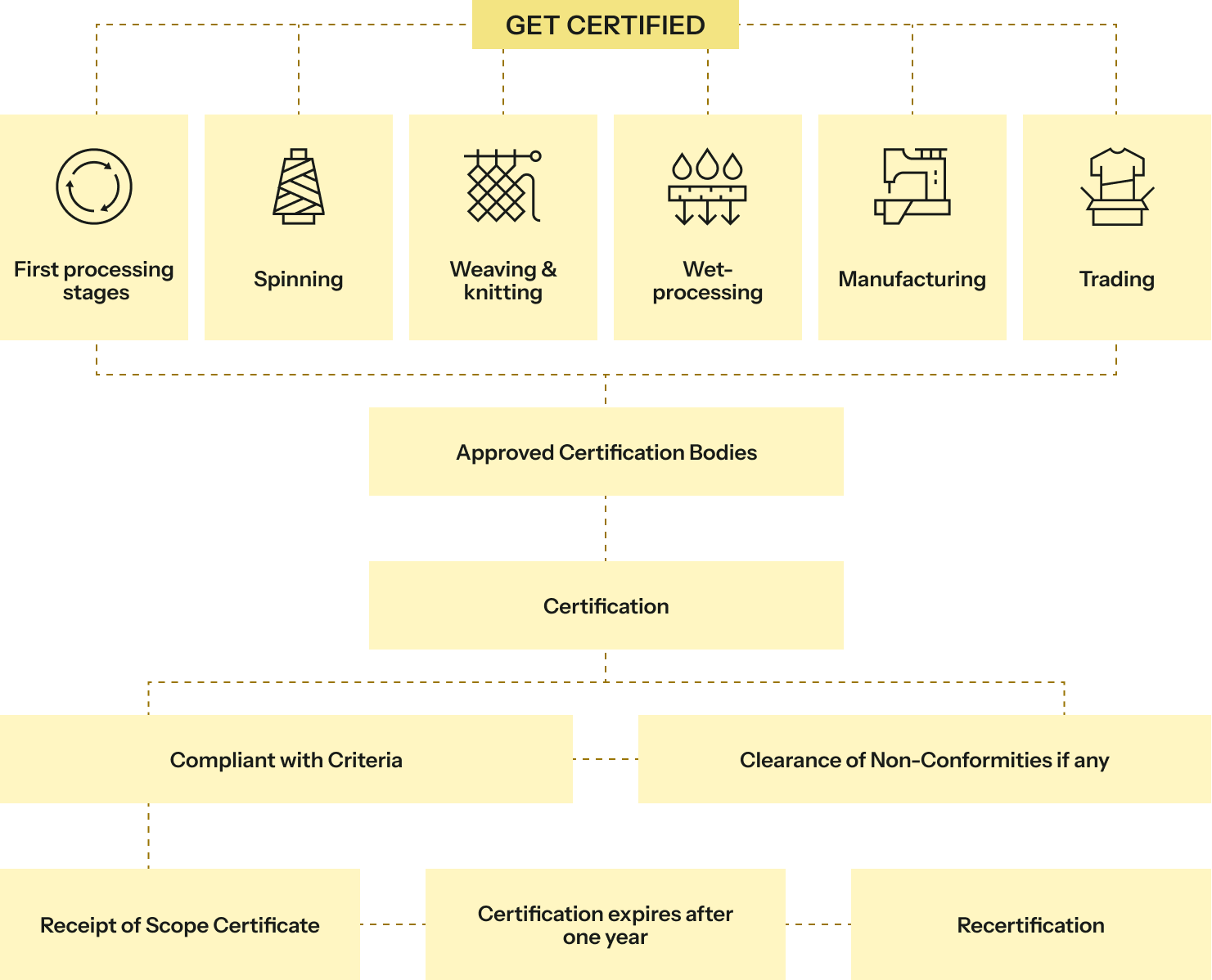 [Read more …Get Certified](https://global-standards.org/certification/get-certified) ## [Who Needs Certification](https://global-standards.org/?view=article&id=51:who-needs-certification&catid=9) # Who needs certification  [Read more …Who Needs Certification](https://global-standards.org/?view=article&id=51:who-needs-certification&catid=9) ## [Certification](https://global-standards.org/certification) # Certification - ### How to get certified Click here to find a step by step guide on how to get certified to GOTS and/or GRTS [Get certified](https://global-standards.org/certification/get-certified) - ### Approved Certification Bodies Click here to view a list of all approved Certification Bodies globally [Find CBs](https://global-standards.org/certification/acb) - ### Get inputs and chemicals approved [get approval](https://global-standards.org/certification/get-inputs-chemicals-approved) - ### Approved consultants [Find a consultant](https://global-standards.org/certification/approved-consultants) [Read more …Certification](https://global-standards.org/certification)