'Organic' is a regulated term used to distinguish systems of managed production and products derived therefrom that adhere to principles of health, ecology, fairness and care, and which are certified compliant to an organic standard's regulations by an Approved Certification Body.
GOTS defines organic textiles as being made with fibres from organic agriculture systems that are certified to one of the IFOAM Family of Standards, and that are processed in socially and ecologically responsible ways, in alignment with organic principles.
standard glossary text
") [GOTS](https://global-standards.org/resources/glossary/gots "The worldwide leading voluntary sustainability standard for the post-harvest textile value chain for certified organic fibres, covering environmental criteria, human rights, social criteria and business conduct.
") requires for the use of fibres that are certified to Organic [Standards](https://global-standards.org/resources/glossary/standard "standard glossary text
") included in IFOAM’s Family of Standards. This also includes fibres that are certified “[Organic in-conversion](https://global-standards.org/resources/glossary/organic-in-conversion "A product from an operation or portion thereof which has completed at least 12 months under organic management and is under the supervision of an Approved Certifier.
")” for >12 months to Organic standards that document the [transition period](https://global-standards.org/resources/glossary/transition-period "The time period between the publication of a new version of the Standard and its effective date.
"). The IFOAM Family of Standards contains all standards officially endorsed as organic by the Organic Movement. [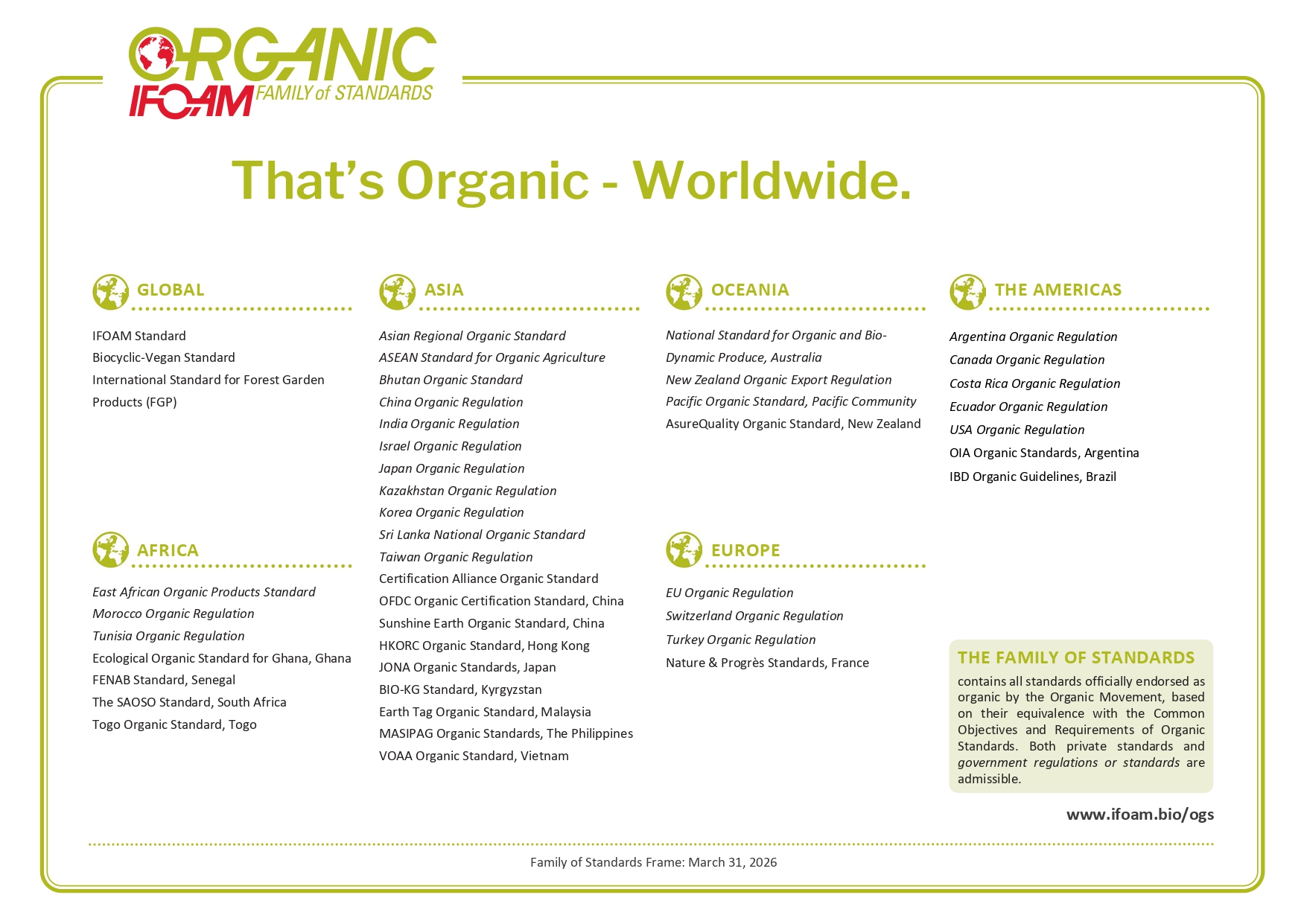](https://ifoam.bio/sites/default/files/2025-02/FamilyFrame_2025.pdf)