Global Standards

Complaint procedure

Principles of GOTS Complaints Procedure

The Complaints Procedure is developed to support the our vision: a world where all textiles are produced in accordance with the principles of health, ecology, fairness and care to enhance people’s lives and the environment. Organic textiles are an integral part of this holistic approach. The Complaints Procedure strives to adhere to the core criteria of legitimacy, accessibility, predictability, equitability, transparency, and is dialogue-based.

The procedure is designed in consultation with experts and external stakeholders to reflect the word and spirit of the core documents, including the Standard, the Manual for the Implementation of GOTS/GRTS and the  Due Diligence Handbook for Certified Entities.

Global Standards strives to continuously improve its Complaints Procedure to ensure it reflects the best international practices and meets the highest expectations for grievance mechanisms, as provided by the OECD Guidance documents and the UN Guiding Principles on Business and Human Rights.

Global Standards provides a complaint procedure to ensure a formalised, timely and effective means of handling and resolving any complaints raised with regard to:

  • unauthorised, false or misleading use of the GOTS/GRTS logo or other claims related to GOTS/GRTS
  • certification failures or omissions in the course of the GOTS/GRTS certification procedure
  • any other abuses of the GOTS/GRTS quality assurance or the licensing and labelling system
  • violations against the ownership and other rights of/in the Global Organic Textile Standard / Global Responsible Textile Standard
  • Complaints based on any of the criteria listed can be made by any company, organisation or individual.

In order to formalise and ease the handling of complaints, a specific complaint form has been developed, which complainants are requested to make use of.

GOTS requires all complainants to identify themselves and their affiliations while submitting complaints. Unidentified complaints shall not be entertained. Complainants however have a choice to remain anonymous while complaints are being investigated and GOTS shall always honour such a request, if made.


Fill out the complaint form

1. Your contact details (will remain anonymous, if desired)

Complaint type *
Complaint type
Please choose
Invalid input
Please fill in your name
Please fill in your address
Invalid Input
Invalid Input
Invalid URL. Please fill in the whole website address including http:// or https://.
Do you wish to keep this complaint anonymous? *
Do you wish to keep this complaint anonymous?
Please choose
Did you find the Company/Organisation in the GOTS Certified Suppliers Database? *
Did you find the Company/Organisation in the GOTS Certified Suppliers Database?
Please choose
Please choose your issue *
Please choose your issue
Please choose one or more items

2. Who is this complaint against?

Invalid input
Please write unkown, if not determinable
Please fill with a valid email address
Invalid URL. Please fill in the whole website address including http:// or https://.
Invalid Input
Article was bought online? *
Article was bought online?
Please choose
Article was bought in store *
Article was bought in store
Please choose
Invalid Input

3. Subject of the complaint

At least one answer is required *
At least one answer is required


Please choose from at least one option
Invalid Input

4. Details of the complaint

Please describe your complaint below as precisely as possible, giving the reasons for your suspicion, also any steps taken so far in pursuing it. Please attach all relevant information and documentation.
Invalid Input
Invalid Input
Invalid Input
Relevant information that substantiate the complaint (e.g. scanned samples of false label applications, links to websites where false information is provided; correspondence, certificates or other documents that support the claim). *
Relevant information that substantiate the complaint (e.g. scanned samples of false label applications, links to websites where false information is provided; correspondence, certificates or other documents that support the claim).


at least one selection is necessary
Please upload necessary files

5. Further information / comments

Invalid Input

6. Authorisation

Confirm complaint *
Confirm complaint
Please confirm
Accept data privacy *
Accept data privacy
Please accept the data privacy policy
Please select a region responsible for your complaint request
Invalid Input
After evaluation of your complaint and the information you have submitted, we will inform you about the processing of the complaint and if further information is required to be able to progress it appropriately. GOTS thanks you for making the effort to file this complaint, which will help to assure and further improve the GOTS quality assurance and to safeguard the credibility of the GOTS programme and its labelling system.

The Principle of Legitimacy

The principle of legitimacy in the Complaints Procedure refers to stakeholders’ trust and confidence in the process. This principle provides that the Complaints Procedure is accountable, fair, and transparent, handling every complaint according to established procedures without any bias or manipulation.

  • Global Standards strives to maintain a transparent and accountable complaint-handling process.
  • Every complaint is documented, and complainants have the right to appeal decisions. Additionally, Global Standards safeguards the complainants from retaliation, ensuring that their identities remain confidential.
  • The Complaints Procedure allows complainants to remain anonymous, for example, by engaging with legitimate representatives.
  • If a complaint or grievance is raised concerning non-compliance with the GOTS/GRTS criteria—particularly those criteria derived from international human rights and labor conventions—and the parties involved are not satisfied with the resolution provided by the Complaints Procedure, they have the option to seek further redress or escalate the issue using other available grievance mechanisms, such as National Contact Points for the OECD Guidelines.
  • The Complaints Procedure is managed by designated qualified and experienced Global Standards staff.
  • The development of the Complaints Procedure is reliant on stakeholder engagement and informed by external expertise.

The Principle of Accessibility

The principle of accessibility requires that the Complaints Procedure is known and functional for all stakeholders, including those facing barriers due to language, literacy, education, or socioeconomic factors. The Complaints Procedure is designed to be user-friendly.

  • The Complaint Form is available on the Global Standards website and is the primary means to file a complaint.
  • In certain exceptional cases, Global Standards may accept complaints submitted through other means, including emails.
  • To properly document the complaint-handling process, Global Standards prefers that any communication during the complaints-handling procedure be in written form, with other means of communication being supplementary.
  • Global Standards is committed to publicise, communicate and raise awareness of the Complaints Procedures to all relevant stakeholders in order to ensure broader awareness and usability.
  • The complaint form is designed to be intuitive and accessible, allowing accessibility for any stakeholders facing potential barriers.
  • If a complaint or grievance is raised concerning non-compliance with the GOTS/GRTS criteria—particularly those criteria derived from international human rights and labour conventions—affected parties may refer to grievance mechanisms provided by the GOTS/GRTS Approved Certification Bodies or seek their advice in submitting the complaint through the Complaints Procedure.
  • Given its global scope, Global Standards is committed to continuously improving the accessibility of the complaints procedure across all geographic regions.

The Principle of Predictability

Predictability means providing a clear and known procedure with an indicative time frame for each stage and clarity on the types of process and outcome available and means of monitoring implementation. It ensures that complainants know what to expect and when from filing the complaint to the resolution.

  • Global Standards shall treat every complaint with utmost seriousness.
  • The Complaints Procedure outlines predictable steps in handling complaints, including timelines for responses and appeals, and communicates indicative timeframes to the affected parties.
  • The Complaints Procedure includes clear instructions on the submission, handling and disposal of submitted complaints.
  • The Complaints Procedure aims to inform the Complainant about the status of their complaint.
  • Resolutions or decisions reached through the  complaint-handling process shall be followed by respective stakeholders.

The Principle of Equitability

Equitability, as one of the core principles of the GOTS Complaints Procedure, means ensuring that aggrieved parties have reasonable access to sources of information, advice, and expertise necessary to engage in a grievance process on fair, informed, and respectful terms. This principle aims to balance any power imbalances between the parties

  • Global Standards promotes equitability by providing clear guidelines and support to complainants.
  • This includes providing sufficient information, allowing complainants to understand the process and ensuring they can participate fully and fairly.
  • Global Standards makes efforts to provide necessary information, advice, and expertise to all parties involved.

The Principle of Transparency

Transparency ensures that the Complaints Procedure operates openly, keeping parties informed about the progress of their complaints and providing sufficient information about the mechanism’s performance to build confidence in its effectiveness.

  • Global Standards upholds transparency by striving to keep the Complainants informed about the status of their complaint.
  • Global Standards makes available on its website the current list of entities banned for Certification as a result of complaints investigations.

The Principle of Being Dialogue-based

Dialogue-based means seeking to resolve complaints through dialogue between the stakeholders involved (for instance, between the Certified Entities and the Certification Bodies or between Certified Entities and the affected parties or their representatives).

  • Global Standards strives to ensure that its Complaints Procedure is dialogue-based, focusing on resolving grievances through open and constructive communication between relevant stakeholders involved. This approach helps to find mutually agreeable solutions and fosters a collaborative environment for addressing issues.

Global Standards is on a mission to ensure the highest level of positive social and environmental impact in textile value chains.
vision and mission

Read more …Complaint procedure

Contact

Please use the form to contact us.

For any information about abuses of the GOTS logo or quality assurance system, please fill out the complaint form.

Please enter your name
Please enter your companies name
Please enter your mail address
Please enter the same mail address again
Ungültige Eingabe
Invalid Input
Please choose a state or union territory
Please choose a state
Please choose a canadian province
Please choose a Contact
Please insert a subject
Please insert a message
Data privacy*
Data privacy
You have to check this option

For protection against spambots, please solve the following equation:

Invalid Input

Read more …Contact

Integrity

Integrity measures by Global Standards

Our standards in a nutshell

  • GOTS is a voluntary processing standard for textiles made with certified organic fibres. It sets environmental, human-rights, social, business-conduct, traceability and labelling requirements for applicable certified post-harvest stages. Organic fibre cultivation must be certified under an accepted external organic production standard.
  • GRTS is a voluntary textile standard covering eligible fibre materials and specified environmental, chemical, human-rights, social, business-conduct, traceability and labelling requirements at applicable certified stages.
  • Global Standards operates as an independent non-profit organisation and sustains itself through annual fees of €180 per GOTS certified facility and 450€ per GRTS certified facility.
  • Our programme includes rules, procedures, and measures to maintain and uphold integrity, which are revised regularly.

Rules and framework for integrity

  • GOTS applies to certified post-harvest processing, manufacturing and trading stages. The organic fibres entering the GOTS system must be certified to an accepted organic production standard.
  • Independent, third-party inspection audit and certification of companies. It is done through accredited Certification Bodies (CBs). These are experts in their field, and Global Standards relies on their proven competence, knowledge and experience. All certification decisions are within the responsibility and purview of the CBs. Global Standards does not interfere with the decisions of the independent CBs.
  • Independent accreditation of CBs. Global Standards has developed its own accreditation system for the approval of CBs, as well as for continuous monitoring of the approved CBs. As a prerequisite, CBs applying for approval as a GOTS/GRTS certifier must already hold a valid accreditation to perform certification in accordance with ISO/IEC Guides 17011 and 17065.
  • The Global Standards Quality Assurance Unit (QA) oversees and implements rigorous quality control procedures.

Procedures for integrity

  • All participants in the Global Standards programme are required to comply with the applicable mandatory requirements. The programme’s control measures are designed to identify and address fraud risks within the certified chain.
  • Global Standards has a robust complaint system where any individual or organisation is able to register a complaint about perceived violations of GOTS/GRTS requirements. This ensures a formalised, timely and effective means of handling and resolving any complaints raised.
  • Global Standards reviews all complaints rigorously and works closely with relevant partners (e.g. CBs, ABs) to conduct comprehensive, thorough investigations.
  • Where evidence of non-compliance arises, Global Standards investigates under its applicable procedures and may take action against implicated parties. GOTS and GRTS labels may be used only in accordance with the applicable certification and labelling requirements.

Measures for integrity

The following measures are designed to support verification of organic-fibre authenticity within the certified GOTS chain, with some controls specifically applicable to cotton:

  • Fibres entering the GOTS value chain must be certified organic according to a production standard recognised by the IFOAM Family of Standards.
  • Farmers/ICS groups must register in the Farm-Gin registry before their fibre are permitted to enter the GOTS system. Currently implemented in India, this requirement will soon be in effect globally.
  • All incoming raw material has to be reported to GOTS along with traceability to the respective farm group, including region, state and province of origin. Wherever the production standard provides for it, the TCs are required to be additionally submitted.
  • Raw cotton may not travel more than 500 km from the farm to the certified gin. This shorter trade chain protects vulnerable points and optimises the process for buyers.
  • GOTS approved CBs must verify the Farmers/ICS groups in the farm-gin registry before issuing lint TCs.
  • CBs must verify the Farm Scope and Transaction Certificates (SCs and TCs) of all materials entering the GOTS value chain.
  • CBs must validate relevant traceability and transport documentation.
  • CBs conduct mandatory testing of all seed cotton for genetically modified organisms using ISO IWA 32 protocol, performed by qualified testing laboratories (e.g., ISO 17025), and further tests (such as pesticide residue testing as per section 5.2.7 of standard version 7.0), either randomly or in case of suspicion of contamination or non-compliance, based on the risk assessment by the CBs.
  • Before issuing any TCs, CBs under GOTS must conduct a rigorous assessment including a mandatory plausibility check (volume reconciliation). First processing stage TCs are only issued by CBs after additional validity checks, such as first processing site capacities, stock positions, full traceability evidence back to the farm as well as verified financial transactions between concerned parties.
  • To strengthen integrity and traceability, GOTS also requires that the Farm TC number appears on the first GOTS TC at the ginning stage. The TC must state the origin for raw material, including region, state, and province. This effectively traces material back to the field and adds another layer of accountability to GOTS-certified fibre.
  • CBs perform unannounced audits of gins where there is a high perception of risk.

The GOTS Quality Assurance Unit (QA) additionally performs the following tasks to maintain integrity and transparency:

  • QA performs a comprehensive review of ginner applications in the GOTS database.
  • QA ensures that certified gins are located within a 500-kilometer radius of the farm groups or farms supplying the raw fibres.
  • QA organises, annually, residual chemical testing of certified products that have been randomly picked up from retail stores across the globe to confirm compliance with GOTS criteria.
  • QA periodically sample lint cotton from ginners to assess GMO presence.
  • QA regularly shares a list of potential high-risk entities with all CBs.
  • QA performs random checks of SCs, TCs, and Letters of Approval issued by CBs.

Bans

  • If an investigation uncovers evidence of fraud, the company will be excluded from the GOTS/GRTS programme, in strict accordance with the established complaint procedure. Additionally, the findings will be publicly disclosed on the official Global Standards website.

Withdrawal of TCs

  • Transaction Certificates (TCs) linked to fraud will be revoked by the relevant CBs, and any finished products will be prohibited from carrying the GOTS label.

Upholding Integrity Through Collaboration with Stakeholders

  • Global Standards cultivates a robust and continuous dialogue with both fellow certification scheme owners and key stakeholders within the organic industry, nurturing collaboration across a spectrum of important issues.
  • Global Standards has an ongoing collaboration with Organic Cotton Accelerator (OCA) and Textile Exchange to provide the textile sector with an overview of global laboratories that can reliably conduct GMO testing as per the ISO IWA 32:2019 protocol – a common language among laboratories worldwide to screen for the potential presence of genetically modified (GM) cotton along the organic cotton value chain.
  • Global Standards co-hosted the Organic Cotton & Textiles Conference in Indore, India in February 2023 with partners Organic Cotton Accelerator (OCA) and IFOAM – Organics International. The conference focused on collaborative solutions to industry-wide issues of transparency, integrity and capacity.
  • Global Standards is collaborating with the European Space Agency (ESA) on a demonstrator project that employs AI and satellite imagery to detect organic versus non-organic cotton fields, enhancing the monitoring of organic cotton cultivation systems.
  • Global Standards is in the process of developing a central database that will trace the origins of organic materials across the entire GOTS chain of custody. This database will cover the journey from the raw material's source, through the initial processing stages, and extend all the way to the final product. To ensure the standard's independence from economic influences, a portion of the development costs is being covered by public funding.

Read more …Integrity

Protection

Protection

Protecting the integrity of our voluntary sustainability standards (VSS) means taking action against misuse. We investigate allegations of fraud, misleading claims and the improper use of our labels or references to certification, and apply appropriate sanctions where necessary.

  • Complaint procedure

    Global Standards provides a complaint procedure to ensure a formalised, timely and effective means of handling and resolving any complaints raised with regard to GOTS and GRTS.

    File a complaint

  • Certification bans

    View companies that have been banned from obtaining GOTS or GRTS certification or participating in the input approval system. Publishing bans promotes transparency and helps protect the integrity of our VSS.

    View list

Read more …Protection

Revisions

Revisions

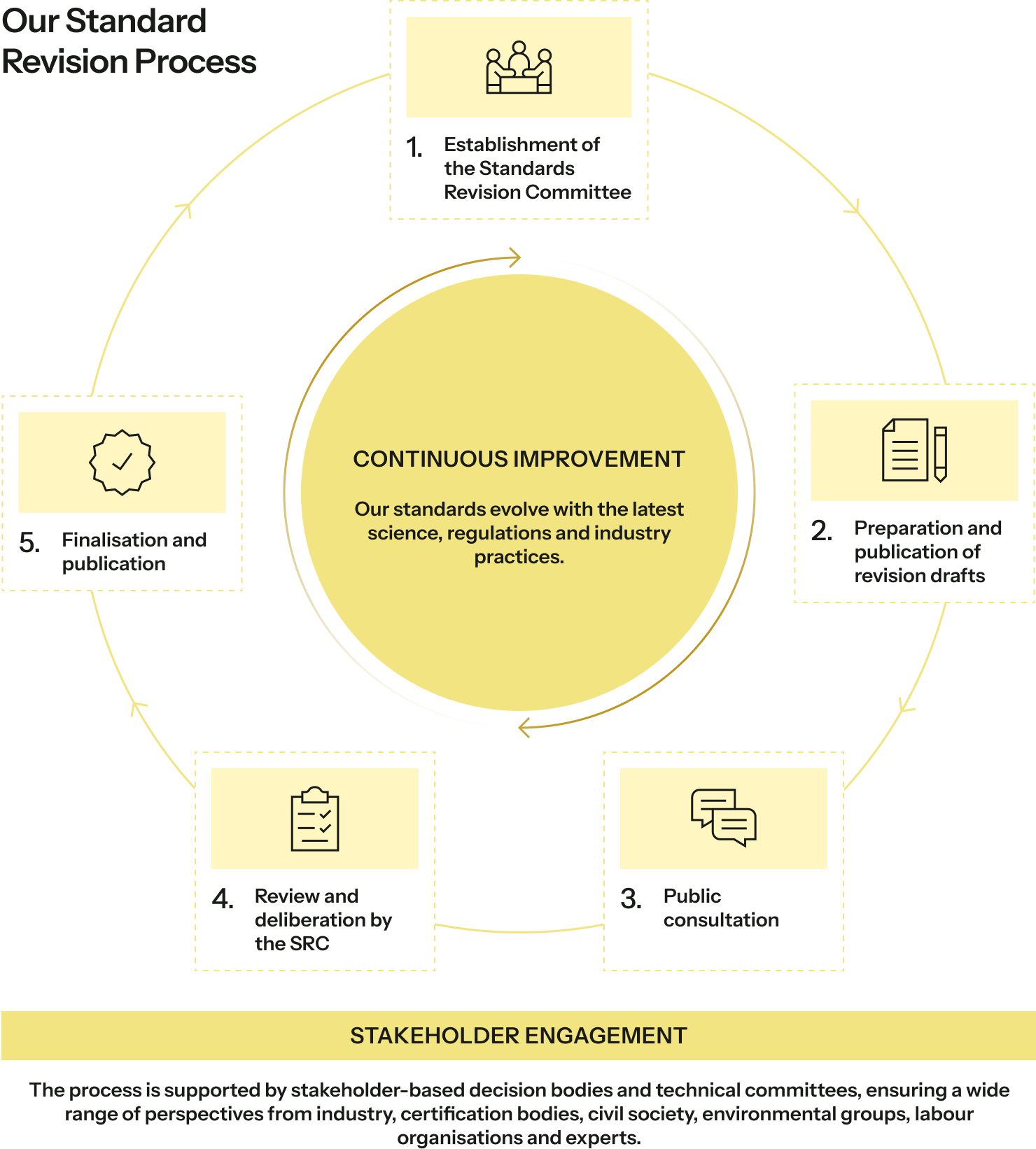
Our standards are dynamic, we foster constant progress towards the development of better textile processing methods. Every three years a revision process takes place in which Global Standards collaborates with international stakeholders. Find out more about our comprehensive and transparent revision process below.

Stakeholder engagement

The revision process is supported by stakeholder-based decision bodies and technical committees so that a wide range of perspectives are considered. Participants may include representatives from the textile and apparel industry, certification bodies, civil society organisations, environmental groups, labour organisations and other relevant experts.

Through this multi-stakeholder approach, Global Standards ensures that revisions are both robust and practical, supporting global acceptance and effective implementation.

Revision process

Standard revisions follow Global Standards’ Standard Setting Procedure (SSP). For each revision cycle, an independent Standards Revision Committee (SRC) is established. The SRC brings together experts from different stakeholder groups and operates under defined terms of reference.

The revision process typically includes:

  • Establishment of the Standards Revision Committee
  • Preparation and publication of draft revisions
  • Public consultation periods to gather stakeholder input
  • Review and deliberation on received feedback
  • Finalisation and publication of the revised standard

This transparent process ensures that stakeholders have the opportunity to contribute and that revisions are developed through broad consultation and consensus.

Public consultation

Public consultation is a key element of the revision process. Draft revisions are made publicly available to allow stakeholders to review proposed changes and submit feedback. Two stages of public consultation are generally conducted to ensure broad stakeholder input, improve the clarity and robustness of the requirements, and allow feedback to be integrated iteratively to strengthen both the quality and practical implementability of the standard. All comments are reviewed by the Standards Revision Committee and considered during the finalisation of the revised standard.

Reference documents

  • Standard Setting Procedure (SSP)
  • Terms of Reference for the Standards Revision Committee
  • Stakeholder Identification Document

For more information, please contact: This email address is being protected from spambots. You need JavaScript enabled to view it. 

Read more …Revisions

Governance

Governance

Global Standards gGmbH operates as a non-profit, with strategic guidance provided by its sole shareholder, the Global Standards Foundation. Through this independent organisational model, a single strategic governing body, the Governing Council, oversees the organisation’s operations.   

Governing Council

The Governing Council is the Foundation’s governing body and is responsible for overseeing both the strategic direction and the ongoing management of its operating unit Global Standards gGmbH guided by Global Standards’ Vision and Mission.  

The Council consists of nine members drawn from diverse backgrounds and areas of expertise relevant to Global Standards’ work. Members are elected through a defined process for fixed terms. The Council itself elects new members if members leave.  

Through its independent oversight, the Governing Council ensures that Global Standards remains accountable to its mission and operates in the public interest.  

Certifiers Council

The independent, accredited Certification Bodies form the basis of the monitoring system for all Standards, currently GOTS and GRTS. This serves to provide credible assurance of the certified textiles’ integrity.  

To facilitate their oversight, Global Standards has a Certifiers Council in which each approved certification body is represented by a responsible expert. The Certifiers Council has an advisory function regarding all issues related to the quality assurance of the Standards. The collaboration of all approved Certification Bodies, as well as with their Certifiers Council counterparts, provides a consistent interpretation of the criteria and requirements of the Standards. The Certifiers Council is coordinated by Managing Director Rahul Bhajekar.   

Documents:  

Read more …Governance